

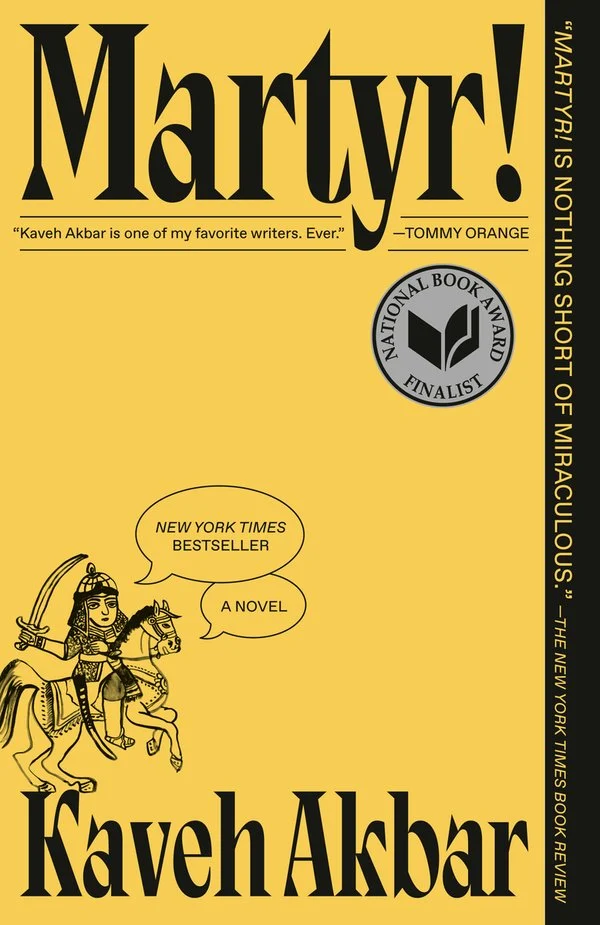
Martyr! by Iranian-American author Kaveh Akbar was a big hit when it was first published in 2024. It was a New York Times bestseller, a finalist for the National Book Award, and it made Barack Obama’s list of recommended reading. However, the first time I read the opening pages, I abandoned the book. The scene starts with alcoholic Cyrus in a filthy room, asking for a sign from God. I was not interested in reading about an alcoholic and I assumed his longing for a religious experience would be treated cynically in the novel. I did not trust these sentences on the second page of the prologue: “He asked God to reveal Himself, Herself, Themself, Itself, whatever. He asked with all the earnestness at his disposal” (p. 4). Earnestness is not fashionable in modern literary fiction. Cynicism is.
When I went back to the book recently, encouraged by acquaintances to try it again, I soon discovered that the book is heartbreakingly earnest. I did have to slog through some cynicism at first, because Cyrus, a recovering alcoholic, is cynical about his life. The death of his father, during Cyrus’s sophomore year of college, hit him hard: “What was left of his life had no intrinsic meaning, he knew, since such meaning could only be shaped in relation to other people” (p. 54).
Cyrus Shams, raised in Indiana, is the child of an Iranian immigrant father whose mother died when he was a baby. This novel is less about growing up between two cultures and more about growing up between life and death. Cyrus’s father Ali discourages Cyrus from speaking Farsi. Afraid of deportation, Ali instructs Cyrus not to tell people where they are from. And when Cyrus balks at the idea of a “Higher Power” and says he needs to find a Persian higher power to believe in, Cyrus’s Alcoholics Anonymous sponsor says, “ ‘You’re the most American kid I know’ ” (p. 25). Cyrus’s cultural heritage is a minor player in this novel.
Death, however, looms large. First of all, the deaths of his parents. And Cyrus seems fascinated by death. Chapter one starts with a sober Cyrus working as a medical actor, impersonating dying people or their relatives, to help medical students deal with dying patients. He is cynical at this point, and his cynicism translated into disdain and even hatred for the medical students he is supposed to be helping.
The chapters about Cyrus navigating his life are interspersed with facts about the plane crash that killed his mother, as well as back-story chapters from the points of view of his mother, father, and uncle. We learn that Cyrus’s uncle had acted as an “angel of death” during his time in the Iranian army. I was impatient with these interludes and did not understand their significance until later in the book.
I would say the book becomes earnest in Chapter 7 (page 71). Cyrus and his friends are in a café for an open mic night and Cyrus begins talking about his fascination for martyrs. He’s been reading about martyrs in the library and has taped printouts of their faces above his bed. He wants his death to be meaningful because he sees his mother’s death as meaningless. “Meaningless at the level of empire is what I mean by meaningless,” he explains on page 75. One of his friends mentions a dying artist, Orkideh, who is doing a performance art exhibit in New York City, talking to visitors every day while waiting to die. Cyrus realizes the artist is Iranian. His friends persuade him to make the trip from Indiana to visit her. What could be more earnest than a search for meaning in one’s life?
I started to love the novel at this point. The book includes several chapters of interactions between Cyrus and Orkideh. It also includes Cyrus’s poems about martyrs from around the world. Cyrus is putting his life back together after years of battling depression, insomnia, and addiction. I don’t want to give any spoilers, but I would encourage you to stick with this book even if you find the first chapters off-putting. I think you will find it richly rewarding, as I did.